From Education to Execution: Lessons Learned From 10 Years of NBLU
by Cynthia Miracle and Scott Mullaney
Published with permission from ASN Kidney News:
Volume/Issue: Volume 18: Issue 8 Publication Date: 07 Aug 2026 Page: 20 DOI: https://doi.org/10.62716/kn.003742026
More than 1 decade ago, those of us working closely with fellows noticed a recurring challenge. Fellows were graduating prepared to manage complex clinical conditions yet had little to no exposure to the business and operational realities of practice. What they did learn about “life after fellowship” was informal and unstructured. In addition, training programs provided only a limited, regional perspective. As a result, fellows often entered practice without a clear understanding of how careers in nephrology manifest.
This educational gap was recognized by us (C.M. and S.M.) in academic medicine and our collaborators in private practice and industry; together, we developed a week-long program attended by four fellows. Feedback from the fellows was overwhelmingly positive, highlighting the value of formalizing this educational activity for other fellows as well. Thus, the Nephrology Business Leadership University (NBLU) was born and has grown to educate over 70 fellows each year.
Designing the program
NBLU’s key objectives have been to prepare fellows for the challenges of transitioning from training to practice, to provide a structured introduction to topics not typically covered during fellowship, and to promote engagement in the nephrology community. We realized early on that fellows graduate unaware of the range of career paths within nephrology, including opportunities in research, administration, advocacy, and education. The program provides exposure to these areas while also addressing practical topics such as finding a job, compensation models, and practice operations.
We designed a curriculum for graduating fellows’ experience. Other resources on practice management exist but are often intended for physicians already in practice. NBLU instead introduces foundational concepts and builds toward a more comprehensive understanding over the course of the week.
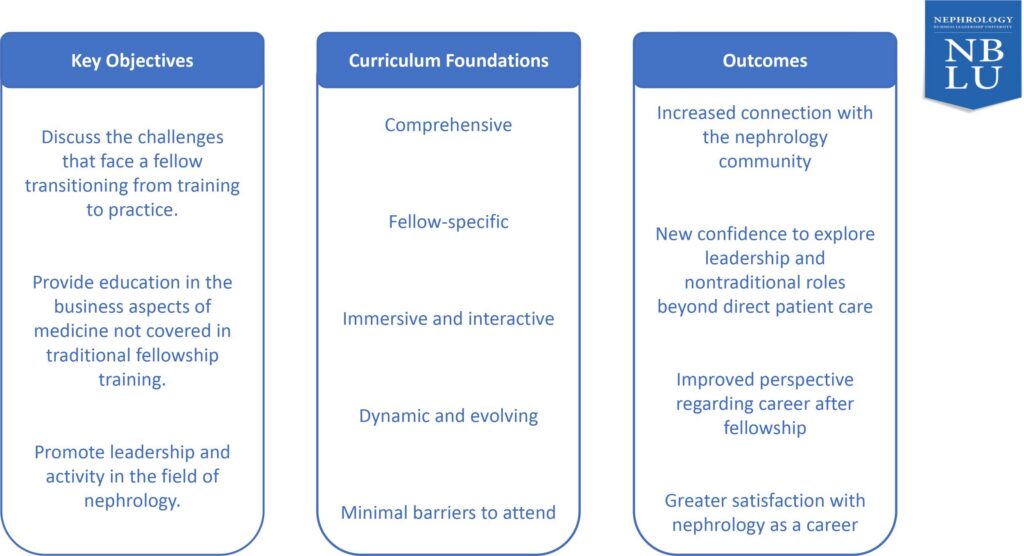
Interactive learning has been a design cornerstone. As the program has grown, we have consistently adapted to preserve attendee engagement. We achieve this by using panel discussions, Q&As, game-based learning, and interactive workshops. In addition, fellows from different training programs are organized into small groups—each functioning as a “private practice.” They collaborate throughout the week, culminating in a competitive capstone project, in which they pitch their start-up nephrology practice to nephrology leaders, using key concepts learned throughout the week.
Embracing a continuing, evolving curriculum
One thing that we have learned is to be adaptable. Every year, feedback from participants, both in real time and via surveys, is collected and used to refine both content and format. Less effective sessions are modified or replaced, and new topics are introduced as needed. As a result, the curriculum continues to evolve from year to year.
The content of NBLU has also shifted to reflect broader changes in medicine. Early iterations included introductions to professional use of social media, which, at the time, was a relatively new skill for many trainees. More recently, the focus has shifted toward understanding social media’s evolving role. Looking ahead, topics such as artificial intelligence, data use, and changes in care delivery are becoming increasingly relevant and will be incorporated into the curriculum.
In parallel, there has been a shift in how trainees approach career planning. Issues such as workload, work–life integration, and long-term career sustainability are now more openly discussed and are an important part of decision-making. NBLU has incorporated these themes into sessions on job selection, career development, and leadership.
One of the program’s strengths has been the collaborative environment that it creates. Fellows from different regions and training programs bring varied perspectives, allowing for comparison of practice models and institutional approaches. This exchange helps participants better understand the diversity within nephrology and the factors that influence career paths.
NBLU alumni
A key component of NBLU is to promote leadership and activity in our field. We are fortunate to have nephrology leaders join us over the course of the week to share their stories and struggles.
After 10 years, the impact of NBLU is evident in our alumni. Graduates have become program directors, division chiefs, practice leaders, and medical directors. In addition, they have become leaders in national organizations, advocacy, and public policy. Many alumni return to NBLU as mentors, panelists, and speakers, offering insights on early career decisions, leadership, and the evolving landscape of medicine. This peer-to-peer mentorship has become one of the program’s greatest strengths.
NBLU was not universally embraced at its inception. Some questioned whether trainees should devote time to learning about the business of nephrology or whether the content would benefit those pursuing academic careers. Others were skeptical about an educational model that combined academia, private practice, and industry. However, we believed it was important to invest in those who had chosen nephrology—helping them build meaningful, sustainable careers. By sharing their experiences with their programs and colleagues, NBLU alumni validated our approach and were instrumental in our acceptance, growth, and evolution. We are thankful for the community-wide support we now have from academic programs, private practice leaders, industry, and society partners (American Association of Kidney Patients, Renal Physicians Association, National Kidney Foundation, and most importantly, ASN). Each of our collaborators has been instrumental in making NBLU a success.
Lessons learned
We take several lessons from this experience. Nontraditional collaborations can provide a multifaceted perspective and offer solutions that may not have been possible otherwise. Also, there is value in explicitly addressing aspects of medical practice not traditionally included in clinical training. Educational programs benefit from ongoing feedback and a willingness to adapt. Additionally, opportunities for interaction and peer learning can be as important as formal content.
Acknowledgments:
We appreciate the contributions from our co-creators of NBLU: Samir Nangia, MD, FASN; Parin Makadia, MD, MBA; and Louise Jacobson and our collaboration with the entire NBLU Oversight Committee, including US Renal Care, the Dallas Renal Group, and the Division of Nephrology, University of California San Diego.